Killior’ra is the local indigenous name for the Turpentine (Syncarpia glomulifera), a common forest tree that dominated the original vegetation of this area. In 1805, naturalist George Caley in company with his companion and friend Dharug man ‘Dan’ Moowattin made a return journey on foot from Pennant Hills to Narrabeen Lagoon on their ‘journey to the sea’.
On this and other exploration trips, even into the then unexplored Blue Mountains, this remarkable duo discovered, collected and documented a number of native plants and animals - this being the first ‘overland’ trip across the ridges and forest-clad gullies of Ku-ring-gai. Moowattin’s indigenous knowledge enabled George Caley to gain very special insights into our incredible biodiversity.
A list of native plants on this trip was documented by Caley - with both scientific and Aboriginal names. This was the very first time that ‘western’ knowledge and the long-term Aboriginal cultural knowledge was aligned and well ahead of any other such scientific ventures by many decades. The well-known Caley’s Grevillea (Grevillea caleyi) was first collected on this trip.
This duo forged the foundations of knowledge of the colony’s natural ‘green’ treasures. A few years later, Moowattin, in the company of Caley, journeyed to England. He was just the third Aboriginal person to visit England.
As we walk along the trail, we can only imagine what the landscape would have been like in 1805 - no houses, no streets - just the untouched bushland. We can also remember George Caley and Moowattin’s journey and discovery and wonder at their incredible findings.
Unfortunately, no images exist of either George Caley or “Dan’ Moowattin exist – but they will always be remembered for their remarkable friendship and establishing the baseline for our studies of our natural environment.
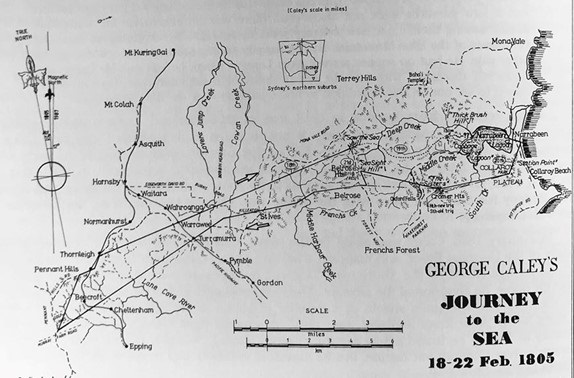
Caley and Moowattin’s 1805 ‘Journey to the Sea’ (across Ku-ring-gai LGA)